
What Letcher Deed Records Convey
Every deed tells four things at once. It names the parties, states the transfer, describes the land, and fixes its place in the public record. The Letcher County Clerk deed page spells out what a recording must carry: party addresses, the consideration paid, a complete legal description, the immediate source of title, preparer and return-mail statements, signatures, notarization, and any other required items.
| Deed Type | What It Does | Common Use |
|---|---|---|
| Warranty deed | Conveys the stated interest with warranties | Documenting a negotiated transfer |
| Quitclaim deed | Conveys whatever interest the grantor may hold | Clearing an asserted interest |
| Fiduciary deed | Conveys through an estate or trust role | Estate administration |
| Commissioner's deed | Records a court-authorized conveyance | Tracing a judicial sale |
| Correction deed | Corrects an earlier instrument | Repairing record details |
Keep the categories straight. Mortgages and liens are not deeds; they record claims or security interests against land. Releases, assignments, easements, restrictions, plats, and affidavits can still change how a deed chain reads.
Letcher Source-of-Title Clues
KRS 382.110 makes the immediate source of title a chain key. The new deed must identify it. If the grantor took title through an earlier recorded writing, that source must be cited. Give its book and page. If title arrived by inheritance, the deed must say how and from whom it came. The same rule covers another route never recorded as a writing.
Read the cited instrument before assuming the current deed repeats every boundary term, exception, or easement. A current deed may not repeat them. After a parcel split, an estate transfer, or a consolidation, more than one source may be needed.
Walk Letcher Deeds by Name
A grantor-grantee index runs on party names, not street addresses. The current owner of record normally appears as grantee on the acquiring deed. That deed names the grantor. He or she becomes the grantee to hunt in an earlier period. Keep repeating the link while dates, descriptions, and references stay aligned.
- Start with the assessment name or grantee in the newest known deed.
- Record its date, grantor, recording reference, and land description.
- Search the grantor as a prior grantee, including initials and entity variants.
- Open each source-of-title instrument and test whether it covers the same tract.
- Grantor
- The party transferring the stated interest.
- Grantee
- The party receiving that interest.
- Chain of title
- The ordered sequence of instruments affecting ownership.
- Book/page or instrument number
- The record's location or unique filing identifier.
Access Letcher Deeds in eCCLIX
The County Clerk records page links to eCCLIX, the deed records portal. Letcher residents may use the private route free of charge for personal, noncommercial research. The portal caps this at five searches per day. Commercial use takes a separate subscription route.
Treat online coverage as unconfirmed until you log in. Image access is not guaranteed. Indexed description fields are not guaranteed. A start year is not guaranteed. At the office, staff can run grantor, grantee, date, document-type, and book/page searches.
| Party | Grantor, grantee, and role, subject to live confirmation. |
|---|---|
| Document | Deed, correction, mortgage, release, lien, plat, or easement. |
| Reference | Date, instrument number, or book/page when provided. |
| Image | Access depends on the account, subscription, or office route. |
Letcher Deeds Beyond the Web
Offline sources reach further back than the web. The clerk places land records as early as 1786. The Kentucky Department for Libraries and Archives inventory lists deed microfilm starting in 1844. A local finding aid gives grantor and grantee index runs beginning in 1848. The scopes differ. The date split stands unresolved.
The Letcher courthouse microfilm finding aid lists index and deed-book reels, surveys, and land entries. The KDLA inventory opens another route to older land transfers. It also covers tax books, wills, entries, and surveys. Give staff a name, a year range, a book and page, and the record type.
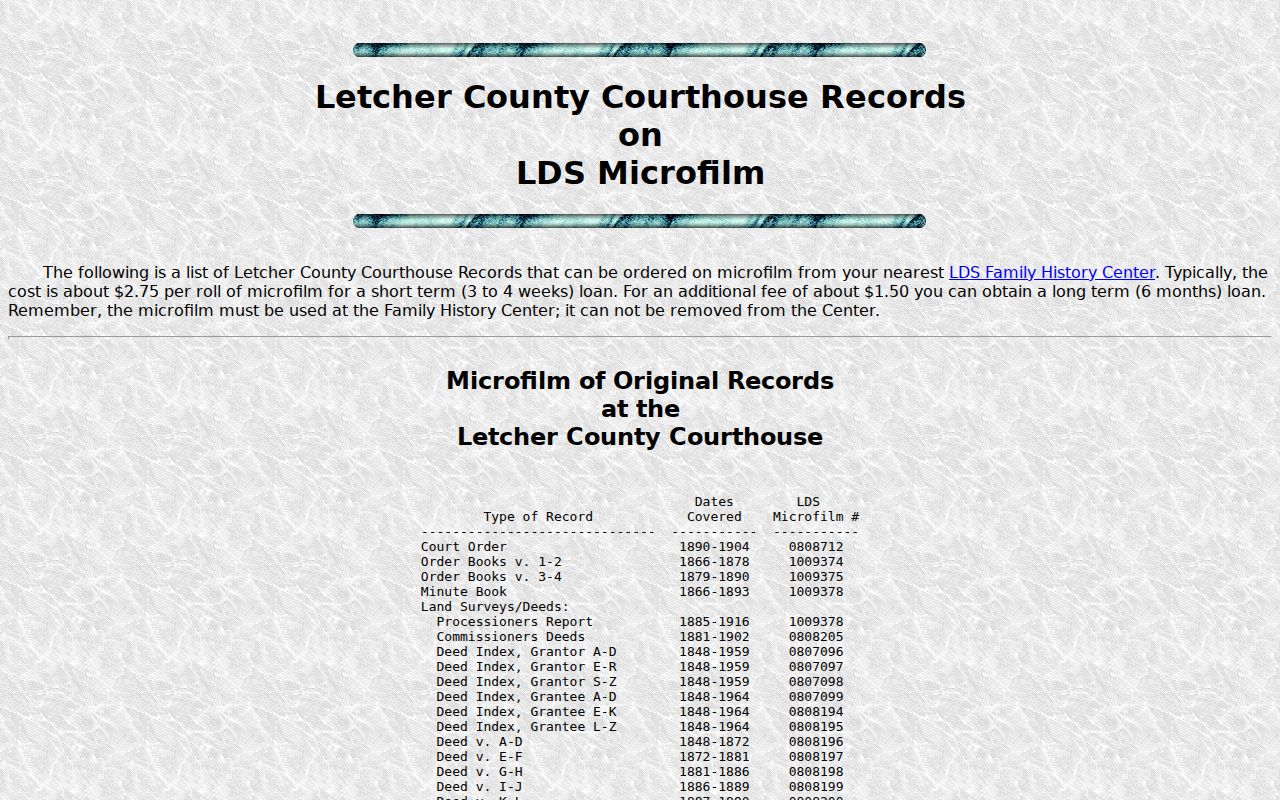
The finding aid rewards precision. A series name and reel reference will serve you better than a broad request for everything filed under one surname.
Note: Confirm the 1786 claim and the correct series with the Clerk or KDLA before citing any earliest deed date.
Survey Books and Deed Indexes Diverge
Early Letcher land research does not begin with one uniform series. The local microfilm finding aid identifies survey books covering 1842 through 1861. It also lists grantor and grantee indexes beginning in 1848, land entries, deed volumes, and court-order material. One gap stands out: Survey Book 3, spanning 1852 through 1854, is missing. That matters when an early metes-and-bounds description cites a survey absent from its expected run.
Search adjacent evidence instead of declaring the title trail lost. The deed book may repeat the survey's calls. Land-entry material, adjoining deeds, court orders, tax books, and wills may preserve the needed names. A later source-of-title reference may carry the boundaries too. Record the exact series title, volume, date span, and microfilm number. Do this before contacting the Clerk or KDLA. A finding aid points to where evidence sits. It is not itself a certified deed record.
Cross-Check Letcher Plats and APNs
A deed's legal description can take many shapes. It might be metes and bounds, a named subdivision, a map number, a lot and block, or an earlier deed reference. Recent Jenkins legal notices give a concrete local example. Maps 6, 7, and 9 appear in Plat Book 1 on pages 104 through 111. Each carries parcel numbers and deed citations. One Map 9 chain leads to a 1948 Pittsburgh Consolidation Coal Company deed in Deed Book 5, page 18.
Treat these references as search anchors, not shortcuts to current ownership. Open the cited plat page. Find the stated lot or tract. Then compare the deed description against the APN and current assessment record. Keep leading zeroes, and test both decimal and hyphenated APN endings. Published Letcher examples use both. Where a split or combination created the modern parcel, the older deed may describe more land than the current tax parcel holds.
Letcher Deed Fees and Copies
Recording a deed in Letcher County costs $50. Corrections and releases run $46. The same fee schedule also reaches mortgages and assignments. It covers easements, plats, surveys, restrictions, affidavits, liens, and other filings. Certified deed copies start at $5. A per-page amount is added beyond that stated base. Surcharge wording varies by row in the schedule. Ask the clerk to confirm the exact total before relying on any figure.
Transfer tax is separate. Letcher County states it as $0.50 for each $500 of value or fraction. It is imposed on the grantor and subject to listed exceptions. It is not part of the recording fee. A copy request and a new recording are different transactions, too. For an existing deed, give the clerk the book and page or instrument number. State whether certification is required, and get the page count before totaling the cost. For a filing, identify every instrument involved and confirm the current fee schedule before submission. Never collapse a consideration amount, transfer tax, recording charge, and certified-copy charge into one number.
Monitor New Letcher Land Filings
Letcher County offers free DOC ALERT enrollment. You supply a name and an email address. When a deed or mortgage bearing that personal or business name is filed, the service sends notice, so an owner can spot the filing early and contact the clerk. An alert does not block recording. It is not title insurance and proves no fraud. Verify the instrument before acting, and compare mailed copy offers with the clerk's published copy fee.
Enrollment keys on the monitored name. One spelling may miss a trust, estate, business, middle initial, or prior surname. Pick variants that match the existing deed records, then review each alert against the actual filed image. An unsolicited deed-copy offer may charge more than the public copy route and add no legal value. Get the instrument from the custodian, and consult an appropriate professional if a filing appears unauthorized.
Estate Instruments Can Complete the Chain
Death does not automatically create a new deed in the county index. A Letcher County chain may pass through a will, probate order, affidavit of descent, fiduciary deed, or commissioner's deed. A later conveyance appears after those steps. A Whitesburg notice shows the linkage. Plat Book 1, page 87, lots 1 through 3 in Block C connect with the James H. Frazier estate. That estate appears in Deed Book 288, page 394. An affidavit of descent follows in Book 397, page 275. Later city acquisitions sit in Books 466 and 467.
Treat that pattern as a method. Do not treat it as evidence about another parcel. Search the decedent and the fiduciary in both grantor and grantee roles. Open every cited affidavit or deed. Compare the legal description at each step. When a court order authorized a sale, obtain the case number and order from the Circuit Court Clerk. Then return to the County Clerk for the recorded conveyance itself. The deed record and the probate file answer related but different questions.
Request a Letcher Deed Copy
The Letcher County Clerk handles deed copy requests on weekdays. Office hours run 8:30 a.m. to 4:00 p.m. A request goes smoothly when it includes the names as recorded, a rough date, and the deed type. Add a book/page or instrument number and a brief property description. Staff can also tell you whether the image is available through an account. An office terminal or a copy request works too.
Kentucky residents may also ask for records by hand delivery, mail, fax, or email under KRS 61.872. Under KRS 61.874, copy and postage costs may be collected in advance. Noncommercial reproduction charges stay limited to actual cost.
Recorded is not guaranteed. Letcher County deed records show what reached the public books. They are not a title opinion, and an unrecorded interest or later filing may alter the result.
When clear title matters, obtain the linked instruments and use a qualified title professional. A Letcher County property search can supply the parcel and assessment name before deed research begins.