
Trace Letcher County Former Owners
Tracing Letcher County former owners means starting at the end. Begin with the newest confirmed deed. Each source-of-title reference points one step back. Log the transfer date, parties, deed type, and book/page for every link. Each entry builds a working timeline. The names below are example roles, not claims about a real parcel. Replace each line with facts read from the subject property's own instruments.
| Transfer Date | Grantor to Grantee | Deed Type | Book/Page |
|---|---|---|---|
| Newest recorded transfer | Prior holder to present grantee | Warranty, quitclaim, fiduciary, or other deed | Copy from the deed |
| Earlier acquisition | Earlier holder to that grantor | Read the instrument itself | Follow the source-of-title citation |
| Estate-linked transfer | Estate or fiduciary to grantee | Fiduciary deed or affidavit of descent | Match deed and probate references |
| Historic transfer | Indexed prior owner to buyer | Deed-book entry | Continue in office or microfilm |
The Letcher County Clerk keeps the land records. Deeds, liens, plats, releases, and wills all sit there, and the office states that recorded land records reach back to 1786. That figure covers the archive, not the web. Use the Clerk's records page for current access choices, and keep the ownership timeline tied to images and exact legal descriptions.
Letcher County's Online Cutoff Gap
eCCLIX is the Clerk's current internet route. Its earliest online year for Letcher County is not published. Private accounts face firm limits. Residents only, personal and noncommercial use, Letcher County records only, and five searches per day at most. Commercial access runs on a subscription. Those limits matter, because an account screen or empty result never proves that an older deed is missing.
When the web runs out, call the Clerk at (606) 633-2432 or visit during its published weekday hours. Ask which years are indexed at the counter. Others wait in deed books or microfilm. Treat the 1786 coverage statement as a description of the archive, not proof that eCCLIX reaches back that far.
Coverage limit: Letcher County publishes no earliest eCCLIX year. Older former owners may require office indexes, deed books, or microfilm.
Letcher County Indexes Begin in 1848
A historic finding aid gives the chain a concrete route once it leaves the web. Its grantor index opens in 1848. A-D runs through 1959. The grantee index also starts in 1848. A-D there runs through 1964, and deed volumes A-D span 1848-1872, with later listed volumes continuing through 1901, though index lines locate a deed rather than replace reading it.
The Kentucky Department for Libraries and Archives reports a broader Letcher deed microfilm run from 1844 through 2010. It also lists tax assessment books from selected nineteenth-century years, surveys from 1842, and wills from 1871. Compare the KDLA land-record inventory with the detailed Letcher County microfilm finding aid, noting that the Clerk's 1786 figure and KDLA's 1844 start describe different source scopes. Preserve both without guessing why.
The historic Letcher County records finding aid displays the volume, year, and microfilm structure. Use it as a map. It points to older ownership links.
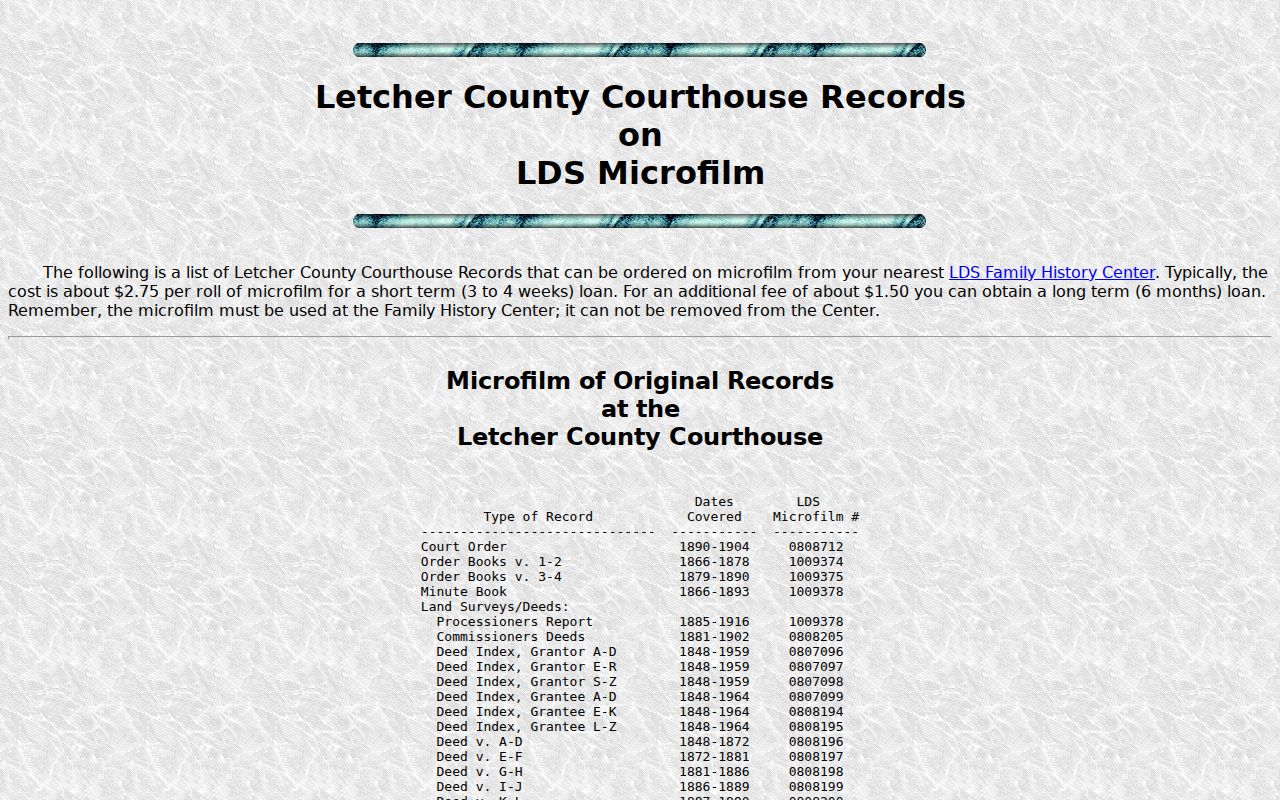
This page is a locating aid, not a live deed image. Confirm its film references with the Clerk, KDLA, or a holding library before relying on them.
Walk Letcher County Deeds Backward
Every deed is both an answer and a pointer. Start with the present acquisition. Confirm that its legal description matches the tract, then follow its citation back. Copy the source of title exactly. Kentucky law requires the prior source and its book/page when title came from an earlier recorded writing, and when it arrived by inheritance or another unrecorded route, the deed itself must state how and from whom.
- Find the latest deed with the current holder shown as grantee. Confirm the APN and legal description rather than matching on name alone.
- Read the grantor, recording date, deed type, and immediate source-of-title book/page. Add them to the timeline.
- Search that grantor as an earlier grantee. Try initials, married names, estate names, trusts, and full corporate names.
- Repeat until the index ends. Continue with the correct letter-range index, deed volume, and microfilm number.
- Grantor
- The party conveying an interest in land.
- Grantee
- The party receiving the interest.
- Chain of title
- The ordered line of instruments connecting one holder to the next.
- Reverse index
- An index used from a named party back toward an earlier transaction.
- Quitclaim and warranty deeds
- A quitclaim conveys the grantor's interest without the same covenants generally associated with a warranty deed.
Letcher County Source-Title Clues
A source-of-title line often teaches the most. It can bridge an address change, parcel split, or new APN by naming the prior writing. Copy punctuation exactly. Letcher County notices use both decimal endings like 023-20-00-099.00 and final-hyphen forms like 023-20-00-094-00. Try both forms. Keep leading zeros.
A legal description outweighs any postal label. Search the subdivision map number, plat book and page, lot and block, road or fork name, and every cited survey. Mailing cities can mislead. A mailing city may not match the incorporated one, and McRoberts ZIP 41835, for example, appears in a Jenkins subdivision context, a search clue rather than proof of municipal boundaries.
Note: Record the spelling and punctuation from every source before testing normalized variants in another index.
Jenkins Coal Deeds Preserve History
A Jenkins-area legal notice offers a rare, specific lead. It names Jenkins Subdivision Map No. 9, Plat Book 1 pages 110-111, Lot 2 Block 3, and APN 023-20-00-094-00. Its source title points to Pittsburgh Consolidation Coal Company and a 1948 deed in book 5, page 18. That name is a historic index term. It makes no claim about today's owner of record.
The clue fits Jenkins's origin as a Consolidation Coal Company model city. Coal-company names sit beside mineral references, utility easements, and lot maps in a single chain. Search the full name first. Then try likely variants. Verify each hit against the map, lot, block, legal description, and source-title citation, because a corporate grantor with a similar name is never enough by itself.
Estates Break a Simple Name Chain
Not every former owner left by way of a normal sale. Kentucky probate starts in District Court when the matter is uncontested. Contested cases head to Circuit Court. Inside the file you may meet a fiduciary appointment, an inventory, an order authorizing sale, a settlement, or a commissioners' deed. Whatever the estate does, the land trail has to come back to the County Clerk before it touches title.
Run searches on several angles. Try the decedent, the estate itself, the personal representative, and the buyer. Add affidavit of descent, executor or administrator deed, and will-related index entries. A death certificate can confirm identity and dates when you can obtain it lawfully. Still, it is not the title instrument. Letcher County wills survive on microfilm from 1871 through 2008. Match each estate record to the APN or the full legal description.
A compact Whitesburg Frazier trail shows how well this works. One public notice ties together Plat Book 1 page 87, lots 1-3 of Block C, and the James H. Frazier estate. Deed book 288 page 394 names the transfer. An affidavit of descent sits in book 397 page 275. Later city acquisitions follow in books 466 and 467.
Letcher Plats Confirm the Tract
Names by themselves invite false links. Two deeds can share a surname yet describe different ground. That is where plats and surveys earn their keep. Jenkins notices cluster around Maps 6, 7, and 9 in Plat Book 1, pages 104-111. A Map 7 example pairs Lot 1 Block 3 with another parcel at 45 Store Hill, APN 028-50-00-023.00. Each element narrows the match a little more.
Older survey work has limits of its own. KDLA holds surveys on microfilm from 1842 through 1943. The local finding aid notes that Land Survey volume 3, covering 1852-1854, is missing. That gap is documented, not proof that related land records vanished. Bridge it with deeds, processioners' reports, commissioners' deeds, court orders, later surveys, and monument calls.
Releases Stay in Letcher History
A release is a later event, not an erasure. The original mortgage or lien stays in the record. Keep mortgages, assignments, modifications, liens, lis pendens notices, and their releases in date order. That sequence helps separate one owner or tract from another. A release often cites the original book and page. That hands you another solid chain link.
For a copy of a single instrument, the separate Letcher County deed records resource covers the Clerk's copy and filing details. Former-owner research rewards focus on sequence, identity, and time depth. A chain built from index lines alone stays incomplete. Check the instrument text and legal description before you trust it.
Reach of Letcher County Ownership Records
How far back can Letcher County ownership records go? It depends on the source. The County Clerk reports recorded land records dating to 1786. KDLA's deed microfilm inventory begins in 1844. Its detailed grantor and grantee index runs start in 1848. No published eCCLIX cutoff exists. No reliable account documents a courthouse fire or a destroyed deed decade, so assume neither.
Stop only after writing down what you searched. Note which spellings and legal descriptions you used, and where access ran out. Then ask the Clerk, KDLA, or a library for the exact volume or film. Historic tax rolls, wills, survey books, court orders, and commissioners' deeds may bridge a gap. But let them say only what they say.
Lawful use. Research prior owners for house history, estate work, or property diligence. Never use land records to track, harass, or harm a living person.